While browsing WordPress, I came across an article where the author expressed strong opposition to ChatGPT and AI‑assisted writing. His concerns centered on plagiarism, dishonesty, and shortcuts — but he misunderstood the purpose of writing aids entirely.
Writing tools are not designed to replace creativity or authenticity.
They exist to support writers — to improve clarity, grammar, and structure, not to impersonate a human voice.
Before I explain the evolution of technology in writing, I want to share the reply I offered to his concerns.
My Reply
What you’re describing is not a technological crisis — it’s a human one.
People have been misrepresenting their abilities long before AI existed.
Plagiarism is not new.
Dishonesty is not new.
Shortcut‑taking is not new.
Integrity is older than any tool, and so is the lack of it.
To assume that every writer who uses AI is hiding behind a façade is an unfair generalization and an insult to those of us who use it responsibly — for grammar, clarity, or structure, not deception.
AI does not erase a writer’s voice; it amplifies the one they already have.
If a writer brings depth, the work has depth.
If a writer brings nothing, the tool cannot supply what isn’t there.
The issue isn’t the technology.
The issue is how people choose to use it — and that has been true of every tool humanity has ever created.
Tools Enhance Human Capabilities Rather Than Replace Them
When I was young, driving was a physical task.
Steering was stiff, and you had to hold on tight because the wheel had a mind of its own. Cars didn’t warn you about anything — if something was wrong, you had to feel it or hear it.
Technology didn’t arrive to replace drivers.
It arrived to support them.
Power steering made turning smoother.
Automatic transmissions removed constant shifting.
Cruise control gave your foot a break on long trips.
Backup cameras helped you see what your neck couldn’t.
Nobody said, “Real drivers don’t use cruise control.”
No one was accused of cheating due to their car’s assistance.
Technology didn’t take away our skill —
it took away unnecessary strain.
AI is no different.
It doesn’t replace your mind or erase your voice.
It simply reduces friction; the same way power steering reduces the fight in the wheel.
Some people fear AI because they didn’t grow through the slow evolution of tools.
But if you’ve ever welcomed cruise control, automatic windows, or a car that tells you your tire is low, then you’ve already accepted the idea:
Technology can make life easier without diminishing you.
Tools Replace Tasks — Not People
Today, we see tools taking over certain tasks in the workplace, and it’s easy to fear that people will disappear with them. But the truth is simpler and steadier: technology replaces tasks, not human value. Every major shift in history — from washing machines to computers to automation — removed the hardest, most repetitive parts of work, not the human judgment, presence, and responsibility behind it.
Take something as ordinary as a laundromat. Washing machines have existed for generations, and Laundromats still exist because not everyone can have a machine at home. And even with all those machines running, people are still needed for maintenance, finances, cleaning, customer support, and managing the place. The technology didn’t replace people; it just changed the kind of work they do.
Fear grows when people believe their job is the task, instead of recognizing that their real contribution is the thinking, the decision‑making, the communication, and the humanity that no tool can imitate. AI may change how we work, but it cannot replace why we work or what we bring. Tools enhance human capability — they don’t erase it.
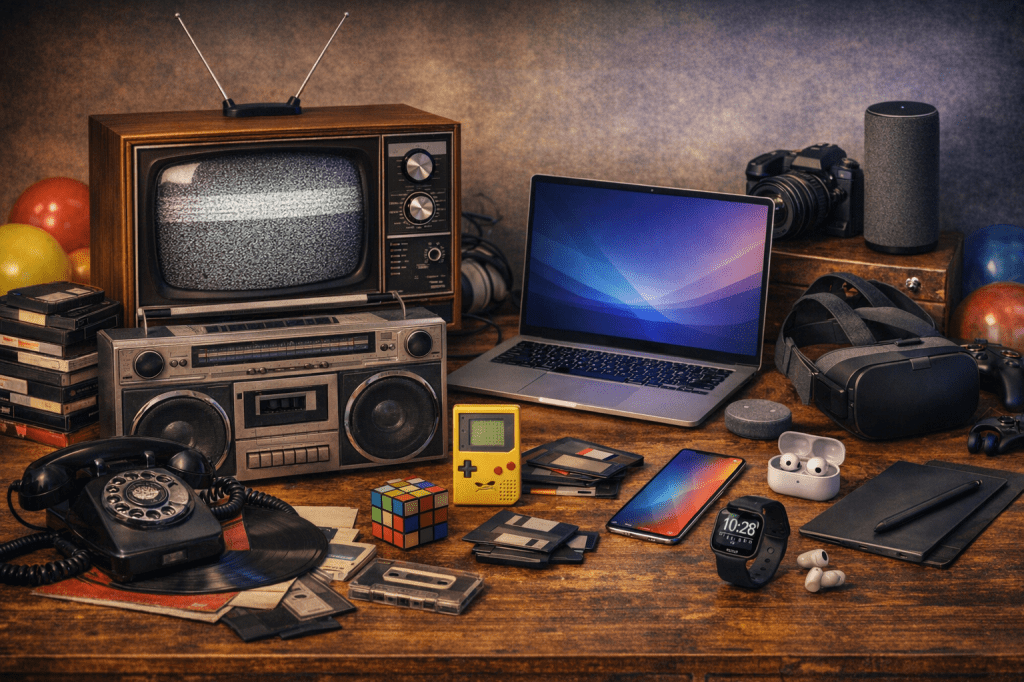
From Knobs and Tubes to Touchscreens: Growing Through Electronics
I didn’t just witness changes in cars —
I lived through the entire evolution of electronics.
When I was young:
- TVs had knobs you twisted
- If the picture went fuzzy, you smacked the side of the TV
- The radio had tubes that burned out
- Record players skipped if you walked too hard
- Phones were attached to the wall
- And if someone picked up the other line, your whole conversation was public
And let’s not forget the hanger.
If the TV signal was bad, you grabbed a metal hanger, bent it into shape, stuck it inside the antenna, and prayed the picture would clear up. Sometimes your body had to stay in a certain spot because you were part of the signal.
We weren’t scared of technology.
We were resourceful.
Then came remote controls, color TV, cassette tapes, VCRs, microwaves, and home computers that weighed more than a child. Dial‑up internet screeched as if it were in pain.
People were nervous then, too —
But we learned, adapted, and grew with the tools.
Today, electronics are smoother, lighter, and smarter.
Your phone can do what an entire room of equipment once did.
No one calls that cheating.
No one says, “real people don’t use smartphones.”
We understand that technology evolves to make life easier, safer, and more connected.
AI is simply the next step.
Technology Has Always Helped Us Heal
If people truly understood how much automation already supports human life, they wouldn’t fear AI — they would appreciate it.
I’ve lived long enough to see technology do things that once felt impossible:
- people walking again with robotic exoskeletons
- veterans using prosthetics that respond to thought
- Children with limb differences are gaining movement
- people who couldn’t speak, finding their voice
- surgeons operating with robotic precision
This isn’t science fiction.
This is happening right now.
Technology isn’t replacing humanity.
It’s restoring it.
It helps people:
- regain mobility
- regain independence
- regain communication
- regain dignity
- regain hope
Automation in healthcare isn’t cold or threatening.
It’s compassionate, steady, and reliable — the helping hand that never gets tired.
And the list goes on:
- machines that help stroke patients relearn movement
- Devices that help people with spinal injuries stand
- tools that help the blind navigate
- systems that monitor heart rhythms
- programs that help people with speech disorders communicate
- surgical robots that reduce complications
If someone fears technology, they should look at the faces of the people whose lives have been changed by it.
Technology has always stepped in where human hands alone could not reach.
AI is simply the next chapter in that same story —
a story of support, not replacement.
The Ethical Line AI Should Never Cross
For all the good AI can do, there is one boundary it should never cross:
impersonating real people.
That is not creativity.
That is not assistance.
That is not support.
That is crossing an ethical line.
When AI is used to mimic someone’s voice, style, face, or presence without their permission, it violates something deeper than privacy — it violates identity. It erases consent, authenticity, and trust. It turns a person into a template, and that is not acceptable.
AI should help people express themselves —
not pretend to be someone else.
It should amplify a writer’s voice —
not steal another person’s voice.
It should support creativity —
not imitate identity.
Impersonation is not innovation.
It’s exploitation.
Technology is evolving, but human ethics must guide it.
And this is one place where the line must remain firm
Technology Evolves — Humanity Guides It
In the end, AI is not the enemy of creativity or integrity — it is simply the newest tool in a long line of tools that have helped us grow, adapt, and express ourselves more clearly. I have lived through enough technological change to know that fear fades the moment understanding begins. From cars that once fought our hands to electronics that required hangers and patience, every generation has embraced new tools and learned to work with them rather than avoiding them. AI is no different. It cannot give depth to someone who has none, and it cannot replace the human heart behind the words. It can help ease the pressure, clear our minds, and back up the efforts we’re already putting in. Technology has always stepped in where human limits begin — not to replace us, but to help us rise. And this moment in history is no exception.
 The Home of Blended Lineage Families