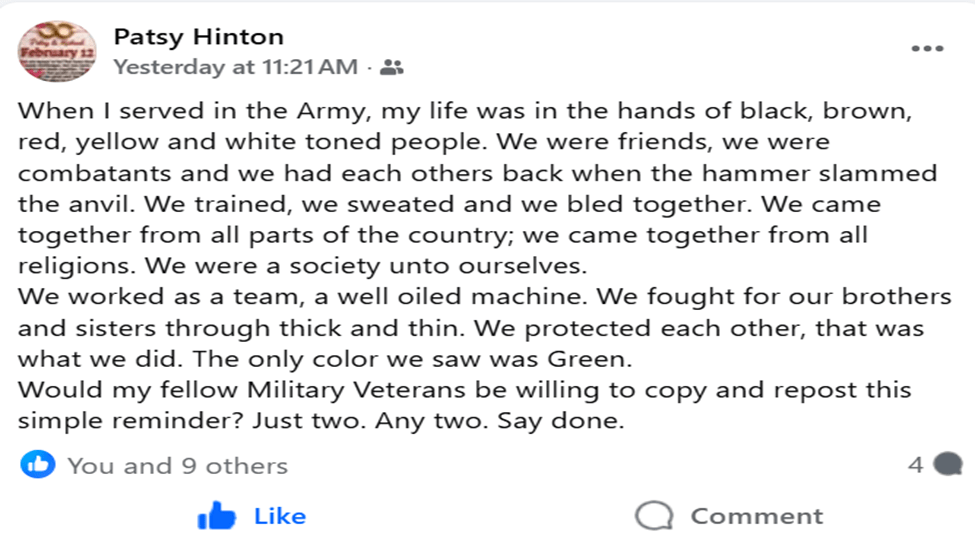
This is a powerful message that was reposted by Mrs. Hinton. This is America. It’s so impactful that I felt it deserved a place here, among our shared and blended heritage.
Black Americans and Military Service
Picture it: a roll call before dawn, boots in wet earth, breath hanging in the air—men stepping forward to defend a country that would not always defend them. Black Americans didn’t just show up to America’s wars—they helped carry them. They marched, sailed, dug in, flew, and came home to the same hard question: Would their sacrifice count the same in peace as it did in war? If we want an honest picture of American strength, we have to tell this story in full—names, labor, risk, and resolve.
Early Service: From the Revolution to the War of 1812
Before the nation had a flag worth saluting, Black people were already in the fight around it. Crispus Attucks fell in the Boston Massacre—one of the first to die in the chain of events that sparked revolution. In the Revolutionary era and into the War of 1812, Black soldiers and sailors served as substitutes, volunteers, and enlisted men—some chasing freedom, some coerced, some simply determined to claim a place in the future. The promise was loud. The reality was uneven. But the service was real.
Civil War and the United States Colored Troops (USCT)
The Civil War forced the question into uniform. Recruiting posters went up, drums sounded, and Black men stepped into a fight that was suddenly also a fight for their own status as human beings and citizens. About 180,000 served in the Union Army as the United States Colored Troops, with tens of thousands more in the Navy. Many were handed the hardest jobs, paid less early on, and threatened with brutal treatment if captured. Still, they marched into fire—at places like Fort Wagner—proving with their bodies what the nation kept arguing with its mouth.
World Wars: Valor, Restrictions, and Recognition
In the World Wars, the uniform was still segregated—but courage doesn’t wait for permission. In World War I, the Harlem Hellfighters fought so hard that France pinned honors on them even when home was slow to do the same; soldiers like Henry Johnson became legends for refusing to give ground. In World War II, the Tuskegee Airmen took to the sky and built a record that undercut the lie that Black excellence needed an asterisk. The country often tried to place limits on its roles. They answered by expanding the meaning of what was possible.
And if you think the story is only told at the trigger and the cockpit, remember this: wars are also won in the quiet work that keeps people standing.
Black Women in World War II: The 6888th and the Work That Kept Morale Alive
And not all services came with a rifle. In World War II, Black women were often funneled into support roles—and then they turned those roles into a mission the war effort could not afford to lose. The 6888th Central Postal Directory Battalion—an all-Black, all-women unit—was sent overseas to untangle mountains of undelivered mail stacked in warehouses. They ran around-the-clock shifts, built name-by-name tracking systems, and moved letters fast enough to turn silence into contact again. A photo, a birthday card, a few lines that said “I’m still here”—that kind of mail can keep a person upright. They weren’t “just stuffing mail.” They were restoring morale, order, and connection—delivering hope by the bagful, and doing it with speed, discipline, and pride.
Desegregation and the Long Work of Equal Treatment
Then came the order to make the uniform match the ideal. Executive Order 9981 (1948) directed the desegregation of the armed forces, and the change didn’t stay theoretical for long—because war doesn’t wait for a perfect society. In Korea, units integrated in real time, under real fire, with people relying on whoever was in the next foxhole. But ink on paper doesn’t instantly change assignments, promotions, or the daily temperature of respect. So Black troops kept serving—and kept pressing the question the country could no longer dodge: If we can be trusted with the nation’s defense, why are we still fighting for fair treatment inside the ranks?
Modern Service: Leadership, Legacy, and Belonging
Today, in the all-volunteer force, Black Americans serve everywhere—on flight decks, in infantry squads, in hospital wards, at command tables. The country has seen Black leadership at the highest levels, including figures like Colin Powell, whose career symbolized doors opening that once were sealed shut. And yet history leaves fingerprints: opportunity, discipline, and belonging are still debated because people still live the outcomes. Honoring Black military service means more than applause. It means doing the hard, ongoing work of fairness for people carrying the same mission, the same risk, and the same flag.
Patsy Hinton and her husband both served and met in the military. Patsy paints a picture of a place that worked: a unit that functioned, leadership that set the standard, and a culture where doing your job well actually meant something. In her eyes, the military was a model of what a blended America can look like when it’s done right—shared mission, shared rules, shared respect. Not like it once was. Proof that progress isn’t a theory; it can be lived.
We have come a long way—too long to suddenly try to go backward. What Patsy lived is worth protecting: not nostalgia, but a standard.
Blended military service tells the truth about patriotism: it’s not a feeling—it’s a decision, repeated under pressure. It’s showing up when the country is in danger, even when the country hasn’t fully shown up for you. And it’s also building institutions where people from different walks can rely on each other without hesitation. So, when we talk about unity, let’s be precise. For generations, America’s military has been blended—long before the nation admitted it. When the stakes were life and death, unity wasn’t a slogan. It was survival.
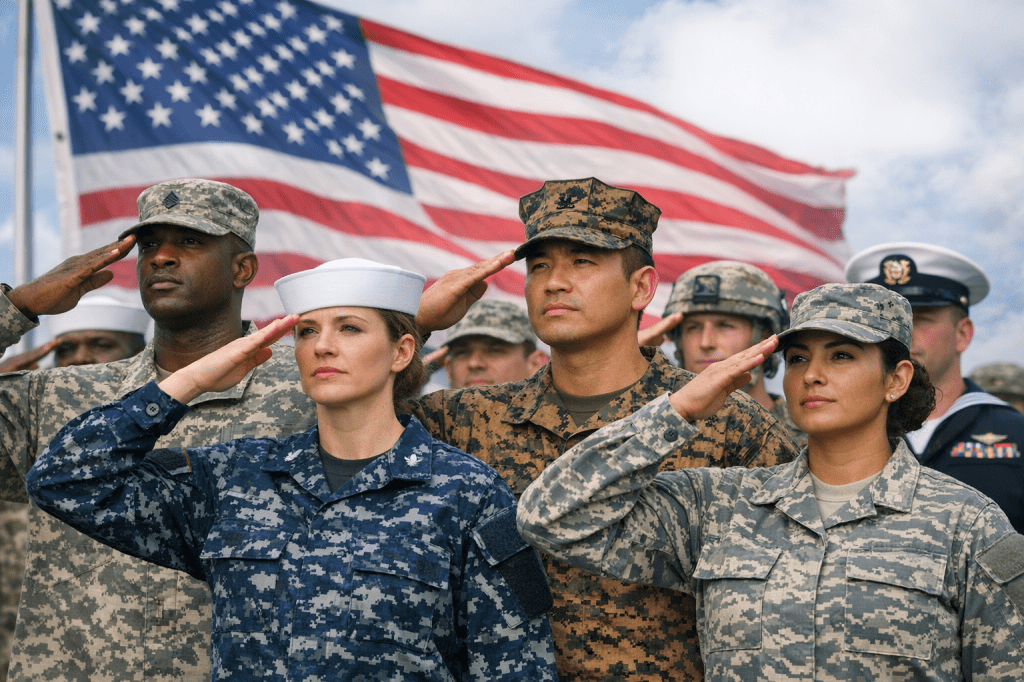
“United We Stand”
 The Home of Blended Lineage Families